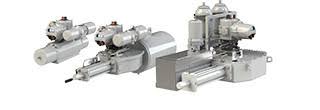
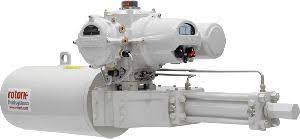
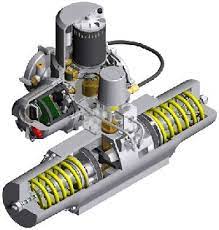
SI actuators for quarter-turn application:
SI2 - for low pressure by safety position and spring load
SI4 by optional hydraulic accumulator, available both in single- and double acting
Hydraulic accumulators provide fail to safe operation in case of power loss and make spring-return actuators faster
- ESD Open / Close / Stay put, - closing direction either CLOSEWISE or COUNTER-CLOCKWISE
Torques and Stroke times:
SI2 - 65 - 4 000 Nm / 5 .. 120 sec by hydraulic fluid work against pistons/ 1,5 .. 300 sec by basic pos. by spring load
SI3 - 2 000 - 36 000 Nm / 15 .. 400 sec by hydraulic fluid work against pistons / 0,5 .. 700 sec by basic pos. by spring load
SI4 - SR - 2 000 - 200 000 Nm / 5 .. 400 sec by hydraulic fluid work against pistons /
0,5 .. 700 sec by basic pos. by spring load
SI4 - DA - 2 000 - 600 000 Nm / 5 .. 400 sec by hydraulic fluid work against pistons / N/A - for spring direction
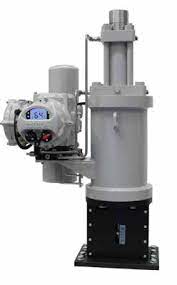
Linear SI actuators:
Linear compact SI actutors for modulating application
SI2 - 1,5 .. 30 kN/ 40 .. 0,50 mm/sec/ 65-105 mm travel
SI3 - 10 .. 235 kN/ 80 .. 1,00 mm/sec/ 65-320 mm travel
SI4/SR - 25 .. 400 kN/ 80 .. 1,00 mm/sec/ travel defined by Customer
SI4/DA - 10 .. 3 850 kN/ 300 .. 0,50 mm/sec/ travel defined by Customer
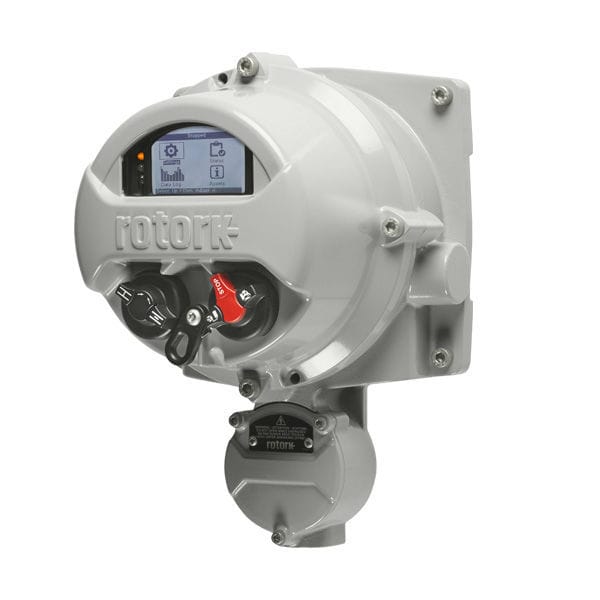
LCD screen, LED-indicators, local control:
Similar like in case smart IQ mk3 electric multi-turn actuators
Pressure and position sensing/ monitoring:
The output torque by each SI actuator origins from the input hydraulic pressure of oil.
Si-has smart self-monitoring function and it checks the current position-pressure values in the whole travel of actuator
As a feedback the SI precisely controls the position and inside pressure. These information are held in datalogger and can be downloaded including dates (days, hours, minutes).
The hydraulic pressure sensor is part of the compact actuator modul.
There are Maximum (e.g.: valve jammed, torque is higher but valve doesn't move) and Minimum values (e.g.: pressure loss due to leakage in the system) can be set that must be indicated by the SI.
Continuous position measurment is needed by a sensor equipment and proportional feedback
This sensor is part of the control modul in case of quarter-turn actuators. In case of linear actuators the sensor is located in the cylinder.
Open or Close terms can be set either at
Position (%) value
Hydraulic pressure value (bar)
Limitswitch boxes:
Can be mounted at any SI actuators and it provides via inspection of status within 10 metres
Red-Green 3D-position indicators by UV-resistant bonnet made of policarbonate for quarter-turn actuators
Control:
For either ON&OFF applications or by ESD and PST controls.
Signal: 24 VDC hardwired as standard, or by analouge4..20 mA, or by optional FIeldbus-interface cards (e.g.: HART, Pakscan, Modbus etc.). Signal transfered through by 2-or 3-wires.
Stepping Control: Can reduce the speed in case both opening and closing direction and in case PST before reaching the preset position - it can be used:
Single-actng actuator: in the direction of hydraulic pressure presence
Double-acting actuator: in both direction can be used
ESD:
Actuators are complied with the requirement of SIS systems based on regulations of IEC61508:2010 - SIL2 and SIL3 are available
ESD-active: actuator only works if it senses ESD signal enabled. As soon as signal loss the actuator will move to the predetermined safety position, there are 3 possible cases:
1. Fail safe incase of either ESD or power supply loss
2. Fail safe only in case of ESD signal loss
3. Fail safe only in case of power supply loss
Case 1: The soleonids are powered from main power supply becuse these equipment are basic part of SIS as well. ESD by 20-60 VDC, or 60-120 VAC input signal the primal aim is to take the actuator to safe position either in case ESD or power supply loss.
Case 2: The power supply isn't part of SIS because it doesn't fulfil all requirement of high safety system. The soleonids works by 24VDC or 24-60 VDC as an option. Actuator moves safety position in case of ESD signal loss and stay put in case of power loss
Case 3: Only Power Supply is need to be considered by SIS requirement, so that ESD is not enabled
Neither of cases means that actuator will stay put in case of power loss
Optional ESD input is available upon request. Primary and secondary ESD signal can be sensed either in one piece of common soleonid or in two separate soleonids.
ESD reset:
Optional input functions are only enabled if ESD signal has been removed.
Additional Safety System by manual reset function - can be seleceted from settings via actuator LCD screen
PST - test:
PST is a kind of functional test that check the possible failures of valve or the actuator in order to avoid ESD input might not generate an output performance.
Tested parts by PST: soleonid valves, flow control valves, bare actuator, the valve itself
Method of PST: Actuator takes the desired position and measure the needed stroke time for such act. It can be performed by remote mode or by Fieldbus interface Card
PST data will be compared with the designed parameters that used at stage of installation (e.g.: stroke time that is critical at SIS equipments. We can check the outcome of the test via LCD screen.
FST - "Full Stroke Test" - it will perform a functional test by full-stroke cycle
Periodical service data stored in datalogger:
Average working pressure (bar)
Duty Cycles (start per hour)
Full time of working periods by the motor
Maximum allowable pressure in each end position
Maximum allowable ambient temperature
Numbers of working cycles
Date of last periodical maintenance
Remote Hand Station:
Using RHS enables the local control from safe distance even within 100 metres. RHS is useful (and also needed) in case of such hazardous environment when the actuator itself can't be approached safely (stay and work near the actuator can be dangerous)
Human interface for control and LCD screen for feedback are the same like in case of IQ(3) range. Data download and upload by using non-intrusive Bluetooth setting tool
RHS can be mounted on pillars, walls, RHS is powered by the actuator itself
Manual Override option:
By Hand pump + padlockable selector knob (pump unit), in case of SI-2 range 2nd stage gearbox can be applied
The selector basic position - NC - by electric operation
In case of either power or signal loss, selector must be rotated to the manual mode. After that the actuator can be operated by the hand pump. For DA-type actuators the direction of rotation can be set for hydraulic operation.
Manual Override option: ESD can't be sensed so that manual override isn't part SIS (Manual mode has higher priority than ESD mode)